
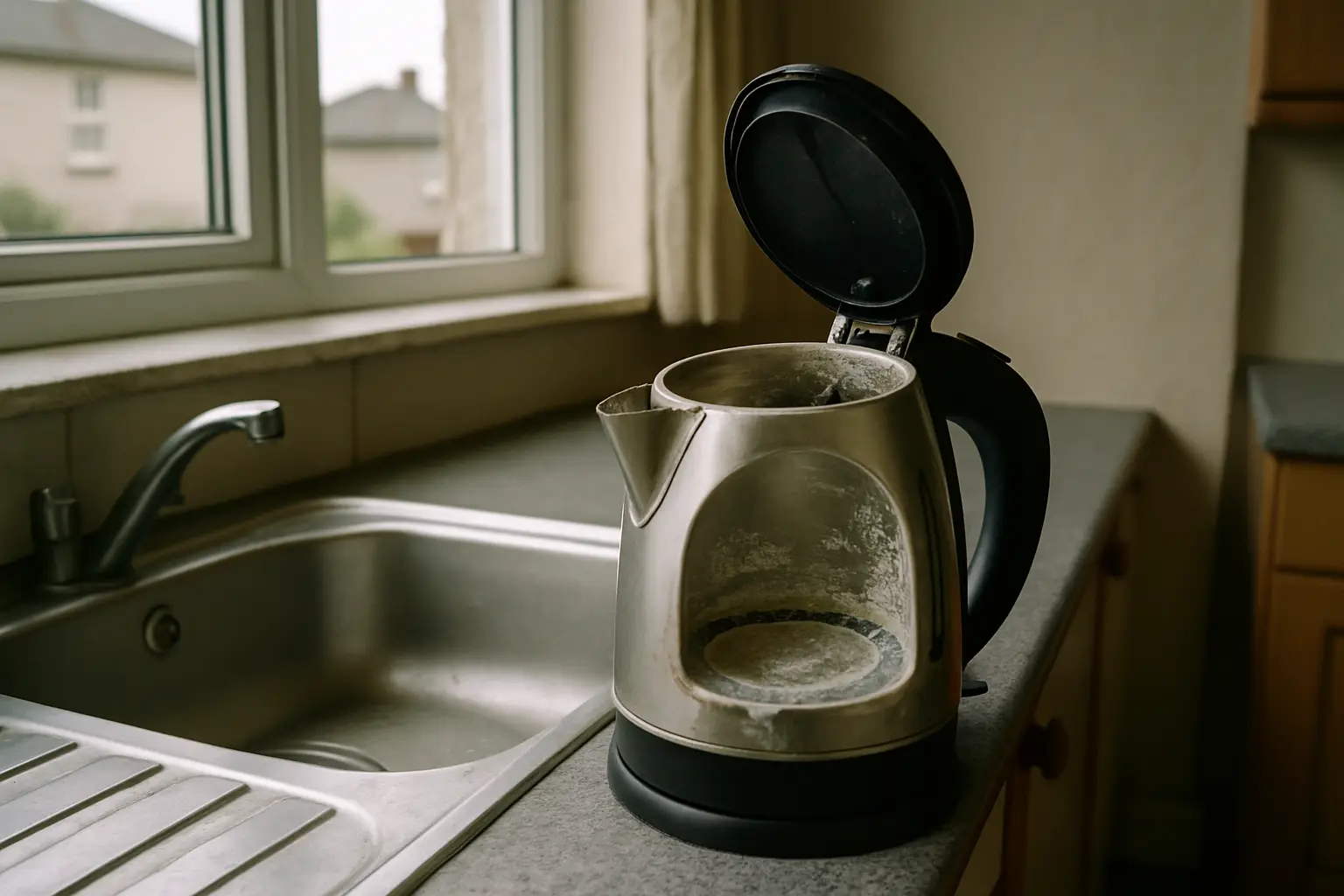
How do you descale a kettle? Half-fill it with fresh water, stir in one to two tablespoons of citric acid powder (or top up the rest with white vinegar instead), boil it, then leave the solution sitting for fifteen to sixty minutes before rinsing thoroughly and boiling a fresh batch of plain water to clear the taste. Citric acid is a food-grade powder with no strong smell, which makes it a comfortable everyday choice, while white vinegar does the same job with something most kitchens already have in the cupboard. Either method breaks down the same problem: limescale, the chalky mineral crust that hard water leaves behind every time the element heats up.
Why kettles scale up so fast
A kettle heats the same water again and again, so it concentrates whatever calcium and magnesium that water was carrying far quicker than a tap or showerhead ever does. That is why the inside of a kettle often looks chalky months before scale shows up anywhere else in the kitchen. Ireland's water hardness varies a good deal from one supply to the next, and Uisce Éireann notes that hardness can differ even between two areas in the same county. You can check the hardness for your own address by entering your Eircode on the Uisce Éireann water quality tool, which is worth doing before deciding how often your kettle actually needs attention.
How to descale a kettle step by step
- Empty the kettle completely and half-fill it with fresh cold water.
- Stir in one to two tablespoons of citric acid powder, or fill the rest of the kettle with white vinegar if you are using that instead.
- Boil the kettle, then switch it off and leave the solution to sit for fifteen minutes, or up to an hour if the scale is heavy.
- Pour the solution away and rinse the inside several times with cold water, working a cloth around the spout and filter.
- Fill with fresh water, boil it once, and pour that away too before making a drink, so no trace of taste or smell is left.
Russell Hobbs' own support guidance for vinegar descaling is specific on this last point: run the kettle through two further cycles of fresh, cold water afterwards to clear any vinegar residue, and only use a descaling product labelled safe for plastic if the kettle body is plastic rather than metal. Skipping the rinse cycles is the most common reason a "descaled" kettle still tastes odd on the next few brews.
Vinegar or citric acid: which to use
Both work by dissolving the calcium carbonate in limescale, but they are not quite interchangeable. White vinegar is cheap and already in most cupboards, though its acetic acid has a strong smell that can take a couple of extra rinses to fully clear. Citric acid, sold as a food-grade powder, dissolves scale just as well without the smell, which is why it suits people who descale often or find the vinegar smell hard to shift. If a kettle has a visible metal filter or an unusual finish, such as copper or a painted exterior, check the manufacturer's instructions before soaking any part of it, since not every finish is designed to sit in an acidic solution.
How often to descale a kettle
Russell Hobbs' own guidance puts descaling frequency down to local water hardness rather than a fixed number of weeks: households on a harder supply need it noticeably more often than those on a soft one. A quick Eircode check on the Uisce Éireann site settles which category a home falls into, and it is worth repeating occasionally since supply zones and any treatment applied to them can change over time. As a starting point, checking a kettle for a visible chalky ring once a month is a reasonable habit, and treating it as soon as the ring appears rather than waiting for it to thicken.
Mistakes to avoid when descaling
Do not top up a vinegar or citric acid solution with any other cleaning product, including bleach. The UK Health and Safety Executive's COSHH guidance warns that mixing an acid with bleach or another chemical cleaner can release a gas that irritates the eyes and airway, and a kettle full of hot solution is exactly the kind of closed, steamy space where that matters most. Keep it to one product at a time, and open a window while the kettle sits with the solution inside.
It also helps to catch scale early rather than letting it build up for months, since a heavily scaled element can take noticeably longer to boil and use more electricity in the process. If limescale is a wider problem around the kitchen, our guide on removing limescale from taps and tiles naturally covers taps, showerheads and tiled splashbacks, and the same citric acid approach works well on a scaled washing machine drum too, covered in our guide on cleaning and descaling a washing machine. If the kettle is just one item on a longer kitchen list, our step-by-step kitchen deep clean covers the rest of the room.