
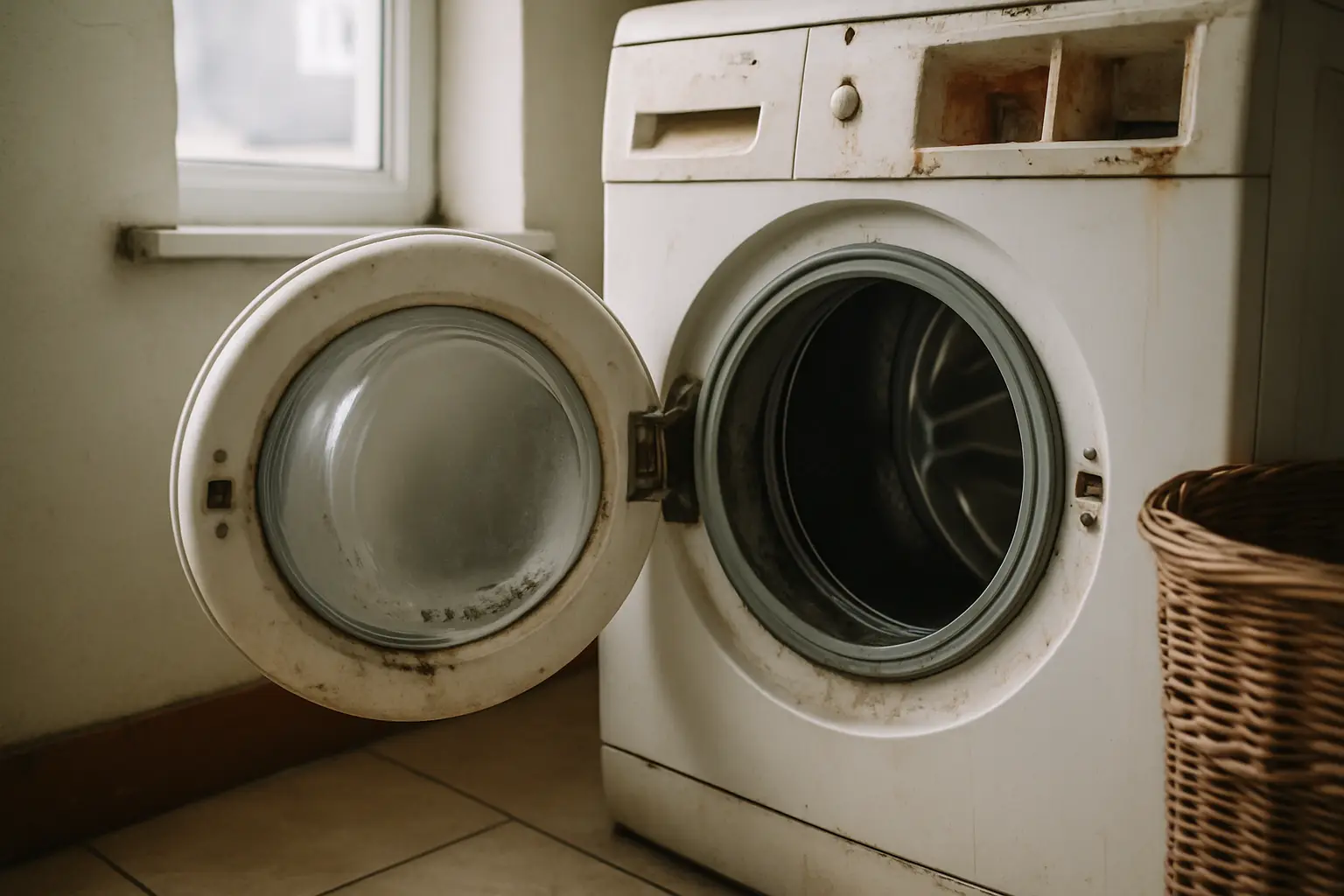
How to clean a washing machine comes down to three habits done consistently: run an empty maintenance wash at a high temperature at least once a month, wipe the rubber door seal dry after full loads, and keep the detergent drawer free of built-up residue. Skip these and limescale, mould and old detergent collect where you cannot see them, which is usually the real reason clean laundry still smells stale. Homes in hard water areas need the maintenance wash more often, because mineral deposits form faster inside the drum and around the heating element.
Why your washing machine needs regular cleaning
Modern machines run efficiently at low wash temperatures, which is good for energy bills but leaves a thin film of detergent, fabric softener and fibres inside the drum and pipework after every cycle. Left alone, that residue becomes a breeding ground for mould and bacteria, especially in the folds of the rubber door seal where water tends to sit after a wash. A monthly maintenance wash, run empty at 60°C or higher with a proper washing machine cleaner, clears that buildup before you can smell it. If odours are already a wider problem in the house, our guide on keeping a home smelling fresh covers the rest of the room.
How to clean a washing machine step by step
This is the core clean. It takes a few minutes of hands-on time plus one wash cycle running in the background.
- Empty the drum and check no laundry, coins or tissues are left inside.
- Add a dedicated washing machine cleaner or descaler to the drum, following the product's dosing instructions.
- Run the machine's maintenance, cotton or "clean" program at 60°C or higher, with no clothes inside.
- Once the cycle ends, wipe down the drum, glass door and rubber seal with a damp cloth.
- Leave the door and detergent drawer open so everything can air dry before the next wash.
If limescale has already built up, for example the machine is running hotter than expected or sounding louder on the spin cycle, use a descaler made specifically for washing machines rather than a general limescale remover. Citric acid and neat white vinegar are sometimes suggested for this job, but stronger concentrations used repeatedly can wear down rubber seals and hoses over time, so a purpose-made product is the safer routine choice.
Cleaning the rubber door seal
Front-loading machines trap a ring of water in the door seal after most cycles, and that damp fold is where black mould usually starts. Wipe around the seal, both inside and outside the fold, with a damp cloth after a wash, and dry it by hand if you are not running another load soon. If mould has already taken hold, a cloth dampened with a mix of white vinegar and water worked gently into the folds lifts most of it. Manufacturer guidance recommends leaving the door and detergent drawer open between washes so the seal can dry out properly, since a closed, damp machine is what lets mould return within days of a clean.
Cleaning the detergent drawer and filter
Pull the detergent drawer fully out (most slide free with a firm tug, or a small release catch underneath) and rinse it under a hot tap, scrubbing the runners with an old toothbrush to shift the paste that builds up from fabric softener. Check behind the drawer housing too, since softener residue often cakes up in the recess and keeps dripping back into a freshly cleaned drawer. Leave the drawer to air dry before sliding it back in. Most machines also have a drain filter behind a small panel near the bottom front, which catches coins, hair grips, buttons and lint. Check it every couple of months, and sooner if the machine has started draining slowly or making an odd noise on the spin cycle.
Hard water and how often to descale
How often a machine needs descaling depends on the water running through it. Ireland's supply varies a lot by area, and a large share of it is classed as hard, meaning it carries more dissolved calcium carbonate that turns into limescale once heated. Uisce Éireann publishes hardness figures by supply zone that you can check against your Eircode, and several zones come back in the hard or very hard range. If you are in one of those areas, or you can already see white, crusty deposits around the door rim or drum, run the maintenance wash more often than the standard monthly cycle. For hard water problems elsewhere in the home, see our guide on removing limescale from taps and tiles.
If the washing machine is only one part of a bigger utility or kitchen clean, our step-by-step kitchen deep clean guide covers the rest of the room, and building appliance care into a regular routine is easier than tackling it as a one-off job. Marking the maintenance wash on a calendar, or pairing it with another monthly chore such as changing bed linen, makes it far more likely to actually happen than relying on memory alone.